HOW TO BE MORE PRODUCTIVE BY WORKING LESS
WORK AS A LINEAR FUNCTION
Most of us, for most of our lives, conceptualize work as a linear function. What I mean by “linear” is that the amount of productive output you create is directly proportional to a number of hours you input.
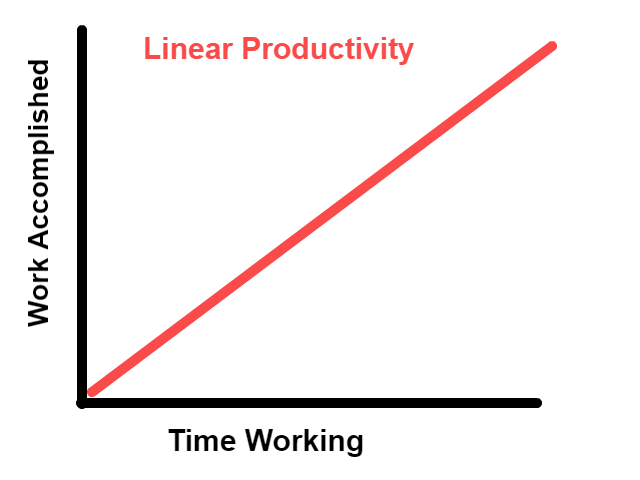
So working two hours will produce twice the results as one hour. And eight hours will produce four times that of two hours.
We all kind of go through life assuming this is the way things work (for the most part). This is mostly because school work functions pretty linearly. They give you a bunch of stuff to memorize, and if you spend two hours memorizing it, you’ll remember about twice as much as if you had spent one hour.
Then we get older and stop picking our noses in public and we just assume that the rest of life will function the same way.
But it doesn’t.
The truth is that most thoughtful, brain-intensive work does not unfold like this. And this feels really unfair to us. So we spend a lot of time complaining to our parents and making excuses that our bosses don’t appreciate our “genius” or whatever.
The only work that is linear is really basic, repetitive stuff. Like hauling bales of hay. Or packing boxes. Or really obnoxious data entry on gigantic spreadsheets. Or operating the fryer at McDonald’s.
Four hours is twice as productive as two hours is twice as productive as one and so on.
Sadly, the “work as a linear function” is where all the religion of “Bro, you’ve just gotta hustle” comes from in the startup world. Since, in their minds, 16 hours of work is twice as productive as eight, the logical conclusion is that you’re all just a bunch of lazy sacks of shit, and you should be putting butter in your coffee at 4 AM and coding until your eyeballs bleed. Hustle, hustle, hustle.
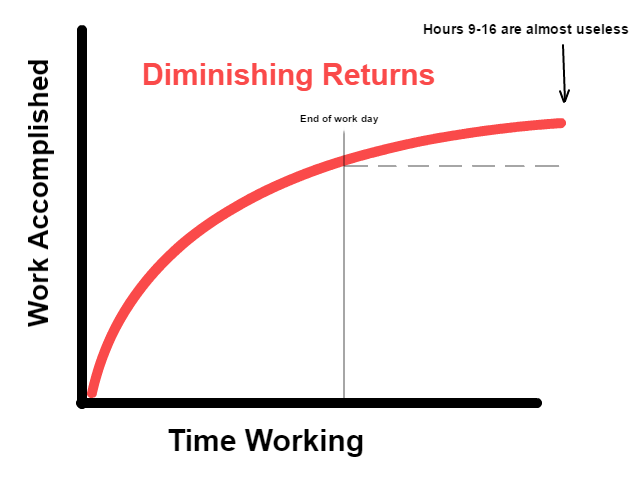
As we’ll see, as well-intentioned and glamorous as the Religion of Hustle is, it often backfires on people. Because the truth is that most types of work (especially work that will make you some money in 2017) does not produce linear returns, it produces diminishing returns.
WORK THAT PRODUCES DIMINISHING (OR EVEN NEGATIVE) RETURNS
Imagine that you went outside and jogged for 10 minutes. This would be a healthy thing to do.
Now imagine you went outside and ran for 20 minutes. It’d also be healthy, but it wouldn’t necessarily be twice as healthy as the 10 minutes.
What if you ran for an hour? Well, you’d definitely push yourself, but chances are you’d still see most of the benefits from those first 10 minutes of exercise.
Exercise has diminishing returns for the simple reason that your muscles tire out. And as your muscles tire out, their ability to be stimulated for further growth diminishes until it’s more or less non-existent. Spending two hours in the gym gets you little to no extra benefit as spending an hour. And spending an hour only gives you slightly more benefit than spending 45 minutes.
Most work is this way. Why? Because, like a muscle, your brain tires out. And if you’re exercising your brain by doing any sort of problem-solving, or important decision-making, then you’re limited in how much you can effectively accomplish in a day.
My wife used to work in the advertising industry and, like many industries, there was a fetish for working insane hours, especially when a major presentation or campaign proposal was due. People would stay late, often working until 9 or 10 o’clock at night. Sometimes they would come in on Saturdays.
But she noticed that most of this extra time was pretty ineffective. The four hours at the end of the day, from say 6 PM to 10 PM, contributed about as much usable work as the first two hours of the day. People were essentially slaving away for marginal benefits.
And in worst case scenarios, people would start producing bad work or make bad decisions because they were so tired. And when you accumulate enough bad work and bad decisions, you actually unintentionally create more work for yourself. So you go from working for diminishing returns to working for negative returns.
You dumbass, now look what you’ve done.
This happened to me when I started working on The Subtle Art. I was hanging out with a few other writers and we’d get together for “write-a-thons” and bang out as many words as humanly possible in an afternoon. It was basically one big pissing contest where we’d gloat about our word counts over drinks later that evening.
My best day was 8,000 words, all in about 6 hours of total work.
“Holy shit!” I thought, “I just produced 32 pages in a single day!” All you would need is 10 days of that kind of productivity to write an entire book.
Comments
Post a Comment